
Introduction
PCD and PCBN tools are the workhorses of modern precision machining.
-
PCD (Polycrystalline Diamond) – for cutting non-ferrous metals, composites, and abrasive materials
-
PCBN (Polycrystalline Cubic Boron Nitride) – for cutting hardened steels and cast irons
These tools are incredibly hard, wear-resistant, and long-lasting. But they don't stay sharp forever.
Eventually, every PCD and PCBN tool needs re-sharpening.
And re-sharpening superhard tools requires a specialized grinding wheel – ceramic bond diamond wheels.
In this article, we'll explore why ceramic bond diamond wheels are the industry standard for PCD and PCBN re-sharpening, and how they deliver the precision and performance that tool manufacturers demand.
Part 1: The Challenge – Re-Sharpening Superhard Tools
PCD and PCBN are among the hardest materials used in manufacturing.
Material Properties:
| Material | Hardness (HV) | Re-Sharpening Challenge |
|---|---|---|
| PCD | ~6,000-8,000 | Extremely hard – only diamond works |
| PCBN | ~3,000-5,000 | Hard and brittle – requires precision |
What Re-Sharpening Requires:
| Requirement | Why |
|---|---|
| Extreme hardness | Only diamond abrasive can cut PCD/PCBN |
| Precision | Tool geometry must be maintained |
| Minimal heat | Heat damages superhard materials |
| Consistency | Every tool must have the same edge quality |
| Surface finish | Smooth edges for better tool performance |
What Happens with the Wrong Wheel:
| Problem | Cause | Result |
|---|---|---|
| Poor edge quality | Wheel too coarse or dull | Rough cutting edges |
| Heat damage | Friction generates heat | Reduced tool life |
| Inconsistent geometry | Wheel loses form | Variable tool performance |
| Short wheel life | Wrong bond for the application | High tooling cost |
Part 2: Why Ceramic Bond Diamond?
Ceramic bond diamond wheels are the preferred choice for PCD and PCBN re-sharpening.
Bond Type Comparison:
| Bond Type | Characteristics | Suitability for PCD/PCBN Re-Sharpening |
|---|---|---|
| Ceramic / Vitrified | Hard, rigid, self-sharpening, porous | ⭐⭐⭐⭐⭐ Best |
| Resin | Softer, self-sharpening | ⭐⭐⭐ Good |
| Metal | Very hard, long life, runs hot | ⭐⭐⭐ Acceptable |
| Electroplated | Single layer, short life | ⭐⭐ Poor for production |
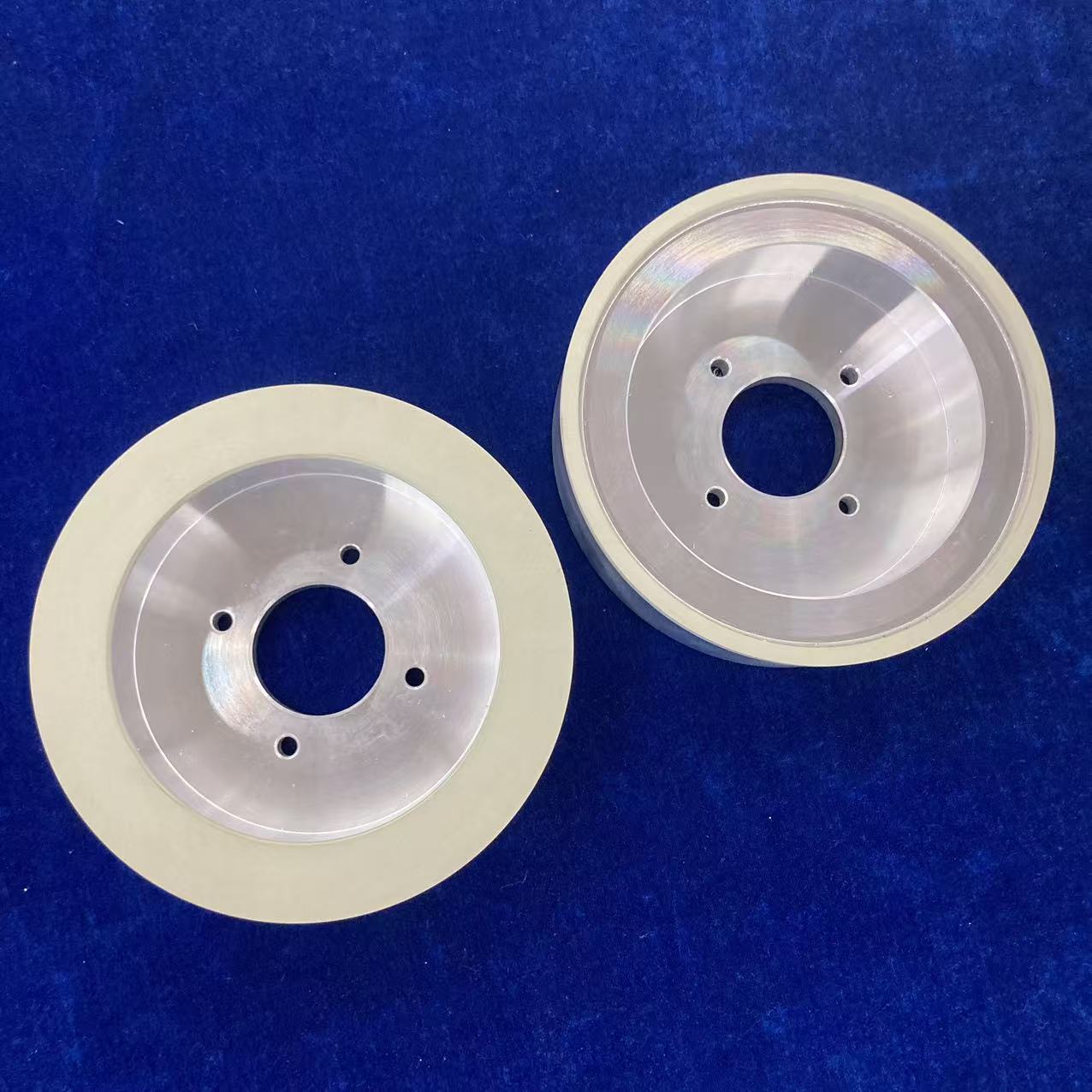
Ceramic Bond Advantages:
| Feature | Benefit for PCD/PCBN Re-Sharpening |
| :--- | :--- | :--- |
| Excellent form-holding | Maintains wheel geometry – consistent edge quality |
| Self-sharpening | Fresh diamond continuously exposed |
| Porous structure | Efficient chip removal and heat dissipation |
| Cooler grinding | Prevents thermal damage to superhard tools |
| Long life | High wear resistance – lower cost per tool |
How Self-Sharpening Works:
| Stage | Action |
|---|---|
| 1 | Diamond grains cut the PCD/PCBN tool |
| 2 | Porosity in the bond allows chips to escape |
| 3 | Dull grains are released as the bond wears |
| 4 | Fresh, sharp diamond grains are exposed |
| 5 | Consistent cutting continues |
Part 3: Why Diamond for PCD & PCBN?
PCD and PCBN are superhard materials. Only diamond abrasive can grind them effectively.
Abrasive Comparison:
| Abrasive | PCD | PCBN | Reason |
|---|---|---|---|
| Diamond | ⭐⭐⭐⭐⭐ | ⭐⭐⭐⭐⭐ | Hardest – cuts both materials |
| CBN | ⭐ | ⭐⭐⭐⭐ | Not hard enough for PCD |
| Silicon Carbide |