
Introduction
Every abrasive belt has a joint.
That joint – where the two ends of the belt are bonded together – is the weakest point of the entire belt. If the joint is not smooth, flat, and strong, the belt will:
-
Leave marks on the workpiece
-
Fail prematurely (break at the joint)
-
Cause vibration and chatter
-
Produce inconsistent sanding results
That's why joint grinding is a critical step in abrasive belt manufacturing.
And the tool used for this job matters enormously.
In this article, we'll explain why sintered diamond cup wheels are the industry standard for sanding belt lap joint grinding – and why they outperform electroplated, brazed, and conventional abrasive wheels.
Part 1: What Is Sanding Belt Lap Joint Grinding?
Let's start with the basics.
How Abrasive Belts Are Made
Most abrasive belts are made by:
-
Cutting a length of abrasive-coated backing material
-
Overlapping the two ends to form a lap joint
-
Applying adhesive (resin) to bond the overlap
-
Curing the adhesive under heat and pressure
-
Grinding the joint smooth – this is where our wheel comes in
What Needs to Be Ground?
After curing, the joint area has:
| Issue | Description |
|---|---|
| Excess adhesive | Resin squeezes out beyond the joint |
| Raised fibers | Backing fibers (cotton, polyester, fiberglass) stand up |
| Thickness variation | The overlap creates a bump |
| Rough surface | The cured resin is not smooth |
The Goal of Joint Grinding
| Goal | Why It Matters |
|---|---|
| Smooth surface | Prevents marking on workpieces |
| Flat profile | Ensures consistent sanding pressure |
| Flush transition | No bump where joint meets backing |
| No burning | Heat damages backing and adhesive |
| Clean cut | Fibers cut cleanly, not pulled |
Part 2: Why This Application Is So Demanding
The materials in a sanding belt joint are extremely difficult to grind.
| Material | Hardness | Grinding Challenge |
|---|---|---|
| Polyester/cotton backing | Tough, fibrous | Abrasive wears quickly; fibers pull instead of cut |
| Cured resin adhesive | Hard, brittle | Conventional wheels glaze over |
| Fiberglass scrim | Very hard, abrasive | Destroys conventional wheels rapidly |
| Abrasive grains (if contacted) | Very hard (Al₂O₃, ceramic, SiC) | Only diamond can grind diamond |
Result: Conventional grinding wheels (alumina, silicon carbide) wear out in hours – sometimes minutes – on this application.
Part 3: The Solution – Sintered Diamond Cup Wheel
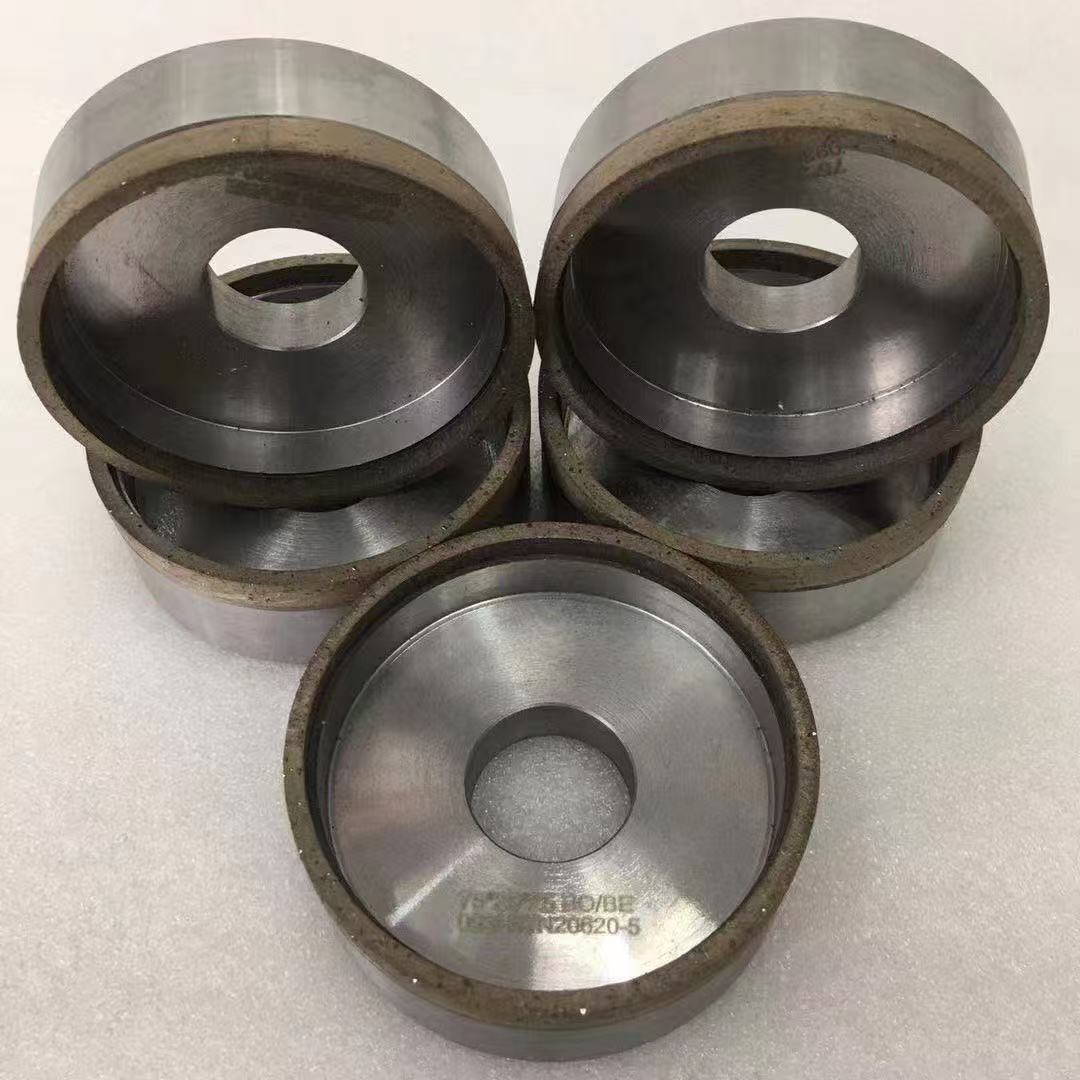
A sintered diamond cup wheel addresses all these challenges.
What Is a Sintered Diamond Cup Wheel?
-
Shape: Cup / cylindrical cup with flat grinding face
-
Abrasive: Industrial diamond (hardest material known)
-
Bond: Sintered metal (diamond distributed throughout the working layer)
-
Dimensions: 75mm OD × 25mm height (standard for belt splicers)
Why Cup Shape?
| Feature | Benefit |
|---|---|
| Flat face | Even contact across the full joint width |
| 75mm diameter | Matches typical belt splicer machines |
| 25mm height | Adequate working depth |
| Open center | Clearance for belt feed mechanism |
Part 4: Sintered vs. Other Technologies
Let's compare sintered diamond to other wheel types for this specific application.
Comparison Table
| Property | Sintered Diamond | Electroplated Diamond | Brazed Diamond | Conventional (Alumina/SiC) |
|---|---|---|---|---|
| Diamond distribution | Throughout bond | Single layer | Single layer | N/A |
| Life (joints per wheel) | 10,000-50,000+ | 1,000-3,000 | 5,000-15,000 | 100-500 |
| Self-sharpening? | Yes | No | No | Yes (friable) |
| Can be dressed? | Yes | No | No | Yes |