

Introduction
Have you ever tried to file a piece of tungsten carbide, ceramic, or hardened steel with a regular metal file?
If you have, you already know the result: nothing happens. The file skates across the surface, leaving no mark – except maybe some scratches on the file itself.
Regular files are made of high-carbon steel. They work fine on soft metals like aluminum, brass, or mild steel. But when you need to shape or finish hard, brittle materials – like carbide, ceramic, glass, or stone – a standard file is useless.
That's where electroplated diamond files come in.
In this guide, we'll cover:
-
What electroplated diamond files are
-
The different shapes and sizes available
-
How to choose the right grit for your application
-
Which materials each file shape works best for
-
Tips for getting the longest life from your files
What Is an Electroplated Diamond File?
An electroplated diamond file is exactly what it sounds like: a steel file body coated with a single layer of diamond grit using an electroplating process.
How It's Made:
-
A steel file blank is shaped to the desired profile (round, flat, triangle, etc.)
-
The blank is placed in an electroplating bath
-
Diamond grit is suspended in the bath
-
An electric current bonds the diamond particles to the steel surface
-
The result is a sharp, aggressive file that can cut almost anything
Electroplated vs. Other Diamond File Types:
| Feature | Electroplated | Sintered (Metal Bond) | Resin Bond |
|---|---|---|---|
| Diamond layer | Single layer | Multiple layers | Single layer |
| Sharpness | Very sharp | Moderate | Very sharp |
| File life | Moderate (single layer) | Long (renewable) | Short |
| Cost per file | Low to moderate | High | Low |
| Can be dressed? | No | Yes | Limited |
| Best for | Small to medium batches | High-volume production | Fine finishing |
For most shop floor, toolroom, and hobbyist applications, electroplated diamond files offer the best balance of performance, life, and cost.
Available Shapes – And What Each One Is Used For
One of the biggest advantages of electroplated diamond files is the variety of shapes available. Different shapes allow you to access different workpiece geometries.
1. Round (Circular Cross-Section)
Profile: Cylindrical, like a round needle file
| Application | Why It Works |
|---|---|
| Enlarging existing holes | Round shape follows the existing hole curve |
| Filing curved grooves | Perfect match for concave surfaces |
| Deburring internal bores | Reaches inside cylindrical openings |
| Radius work on edges | Smooths out internal radii |
Best for: Holes, pipes, tubing, concave surfaces, internal radii
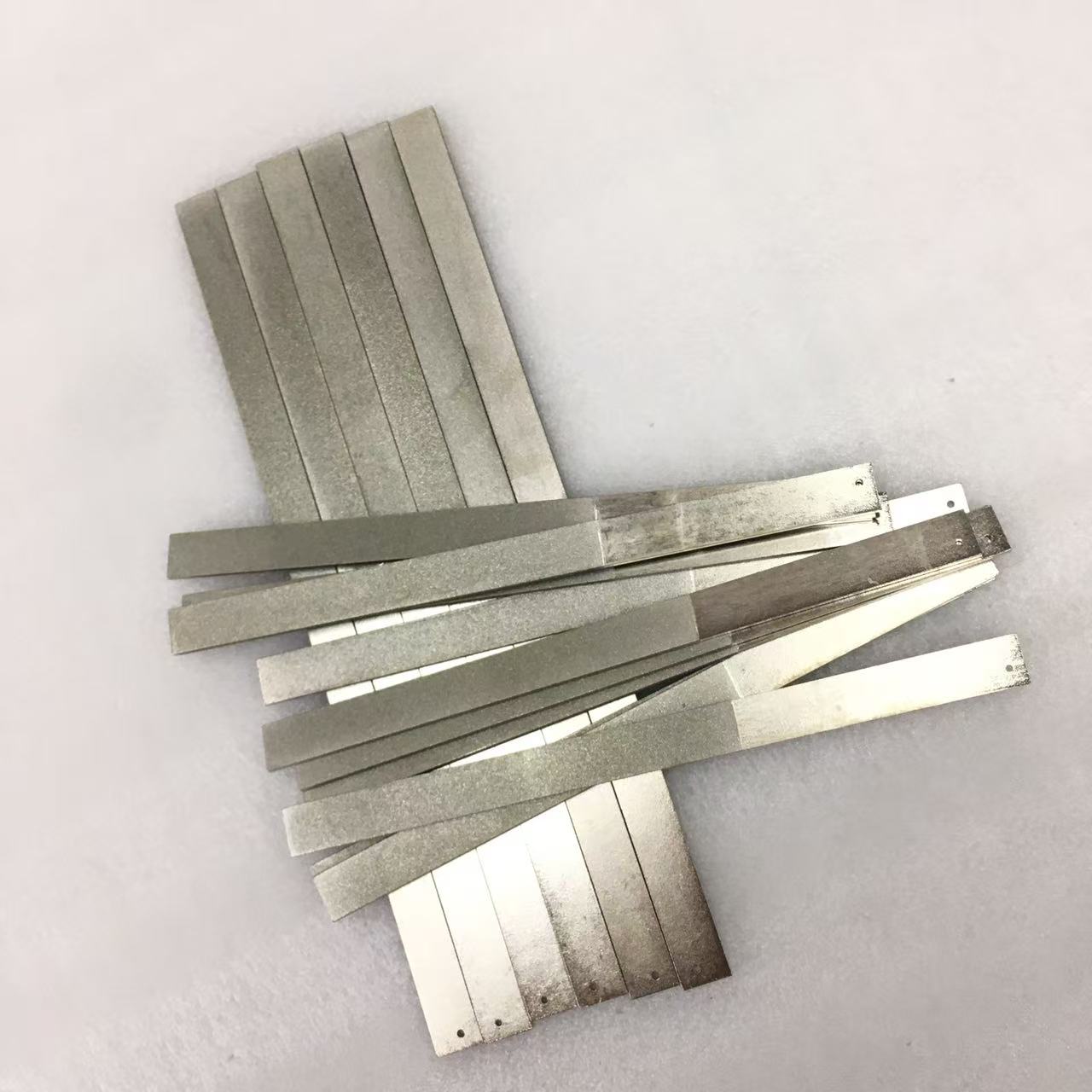
2. Flat (Rectangular Cross-Section)
Profile: Flat on both sides, straight edges
| Application | Why It Works |
|---|---|
| Flat surface finishing | Full contact on flat areas |
| Straight edge deburring | Cleans up sharp corners uniformly |
| General purpose filing | Most versatile shape |
| Creating square shoulders | Precise 90° corners |
Best for: Flat surfaces, straight edges, general purpose filing
3. Half-Round
Profile: Flat on one side, curved on the other
| Application | Why It Works |
|---|---|
| Combination work | One file does both flat and curved surfaces |
| Concave/convex shaping | Curved side matches arcs, flat side cleans up |
| Mold and die work | Ideal for complex cavity shapes |
| Transition surfaces | Smoothly blends flat and curved areas |
Best for: Mold cavities, concave/convex blends, tool and die work
4. Square
Profile: Square cross-section with four flat faces
| Application | Why It Works |
|---|---|
| Square holes | Four flat sides match square openings |
| 90° internal corners | Cleans up sharp internal angles |
| Slots and keyways | Fits into narrow rectangular spaces |
| Gear teeth (square profile) | Files between gear teeth |
Best for: Square holes, slots, keyways, 90° corners
5. Triangle (Triangular Cross-Section)
Profile: Triangular, typically with 60° angles